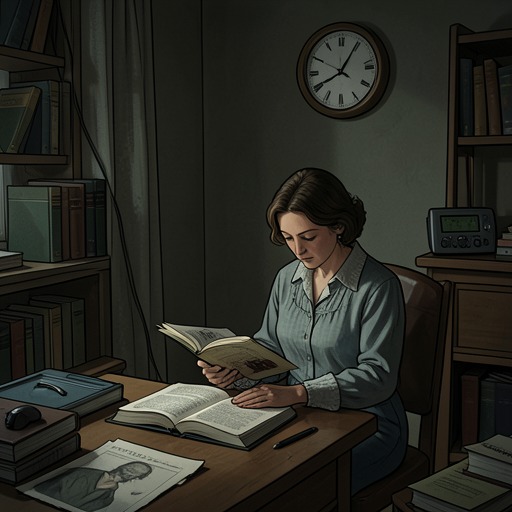
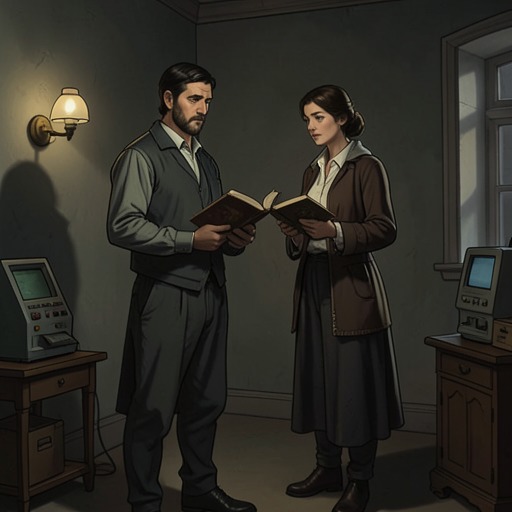
Bénédicte confesses to her husband after the car crash
L'Amour et les ForêtsBénédicte Ombredanne’s confession to Jean-François in the night of May 6–7, 2006, is a rupture produced by an accident and sustained marital harassment. After months of being questioned about her afternoon with Christian, she abruptly gives her husband the truth he has demanded. The outburst briefly reverses the roles between them: instead of defending herself against his accusations, she controls the account and names the intensity of the life she experienced beyond the marriage. Yet the imagined freedom that carries her through the confession does not become an escape; Jean-François’s interrogations return.
Causes and Background
Four days before the confession, Bénédicte was driving past a recently installed abstract sculpture at a roundabout on her way to the lycée. After repeatedly wondering what it represented, she suddenly saw it as a prediction of her own condition: she imagined herself absorbed into its harsh steel. Terrified by this vision, she turned away and was struck by another car. The collision was not physically serious, but it frightened her deeply. She remained still at the wheel, crying, and did not immediately recognize the mental change that the accident had set in motion.
That change emerged in the context of Jean-François’s prolonged campaign of questioning. In the two months after Bénédicte’s afternoon with Christian, he repeatedly demanded details and treated her answers as a means of exposing her. His questioning invaded ordinary life: he called several times a day, woke her at night, confronted her in the morning, and questioned her even while she showered. Bénédicte experienced the accusations as a dense, seemingly inescapable landscape, with each phrase adding to the pressure. The collision did not by itself resolve that pressure; in the account of the event, its force becomes a delayed trigger for speech and bodily resistance.
The confession also follows an earlier moment when Jean-François acknowledged the harm he had caused. After hearing a France Inter program about harassment, he recognized his own behavior in the accounts of victims and admitted that he had treated Bénédicte like a harasser. He cried, apologized, and promised to stop humiliating her or raising a hand against her. Bénédicte answered that he had made such promises many times and urged him to seek psychiatric help. His recognition had briefly allowed her to see her situation from outside his explanations, but it had not ended the pattern of control.
The Confession
In the early hours of May 7, after Jean-François woke her again, Bénédicte got out of bed and threw nearby belongings at him. She switched on the light and declared that she had had a rendezvous with a man, that she had liked him, and that they had made love. Her outburst was not a cautious admission or an appeal for reconciliation. It was delivered with a new force, as she challenged Jean-François to face the truth he had been demanding from her.
She emphasized the contrast between the afternoon with Christian and the years of her marriage. Looking back, she said that the few hours she had spent with a stranger had contained more intense, tender, and sincere experience than a decade with her husband. The comparison made the affair more than a secret to be extracted: in Bénédicte’s telling, it had become the measure by which she could recognize what had been missing from her life with Jean-François. She spoke while pacing the room, indifferent to the possibility that the neighbors might hear her.
Jean-François questioned her until morning. He remained calm and nearly voiceless, while she answered with precision and contempt, turning each response into a reproach. Once she had begun, she recounted the afternoon in detail, and the act of telling seemed to let her live it again. Her account gathered momentum as though it were carrying her toward a dawn in which she would take her belongings and children and leave the house to join Christian. That departure is imagined within the scene, not shown as an outcome. In the moment, Bénédicte felt transformed by an energy that the narration compares to the night she joined Meetic and began speaking with strangers.
Immediate Consequences
The confession brought the children into the scene. Awakened by their mother’s shouting, Lola and Arthur came to the bedroom at different times. They saw Jean-François crying on the bed and Bénédicte standing in the room, furious and animated. Their presence makes the outburst more than a private confrontation: the children encounter a marriage laid bare through their parents’ distress, even as Bénédicte imagines herself wielding the scene’s force like a weapon.
The confession did not establish a lasting settlement between the spouses. At times afterward, Bénédicte believed the ordeal had ended and that Jean-François had absorbed the fact of her affair. She felt able to show a freer, more openly sensual aspect of herself without being mocked. But a day or two later, his anxieties returned, and he resumed waking her at night to demand that she recount what had happened with Christian. He asked for the story again as if replaying it might help him remove its images from his mind; Bénédicte protested that she had already told him several times.
Significance
The event joins a physical shock to a delayed act of speech. The car crash is followed not by an immediate explanation but, four days later, by a reversal in the bedroom: the woman subjected to interrogation seizes the narrative and makes her husband listen. Her words also overturn the explanations that had diminished her suffering. Jean-François had already admitted that his conduct belonged to the same pattern of harassment condemned on the radio; during the confession, Bénédicte invokes that admission as evidence that her humiliation was not something she had invented.
For a short time, the confession gives Bénédicte a perspective beyond the narrow terms of accusation and defense. She tells the story not to soothe her husband but to assert what the afternoon with Christian meant to her and how sharply it contrasted with her marriage. Yet the subsequent return of his nightly demands shows the limits of that reversal. She has spoken openly, but the relationship’s structure remains: he continues to press for control of her account, and the promise of departure remains an imagined horizon rather than the event’s resolution.